Thursday, September 19, 2013

Is the risk of Stillbirth higher with home births vs. hospital births ?

According to the October issue of the American Journal of Obstetrics and Gynecology, the risk of stillbirth is 10 times higher for homebirths.


Researchers at New York-Presbyterian Hospital and Weill Cornell Medical Center, who analyzed data on more than 13 million US births. It is the largest study of its kind, the study's results were confirmed by analyzing birth certificate files from the National Center for Health Statistics to evaluate deliveries by physicians and midwives in the hospital and at home from 2007 to 2010.

The primary outcome measure was the Apgar score: Appearance, Pulse, Grimace, Activity, and Respiration. The researchers looked at Apgar scores of 0, neonatal seizures and neurological dysfunctions. The Apgar test is a screening assessment that quickly studies the health of a baby 1 minute and 5 minutes after being born. If a baby has a 5-minute Apgar score of 0, it is considered stillborn, but the researchers say that 10% of these babies survive.


The Apgar test is usually given to a baby twice: once at 1 minute after birth, and again at 5 minutes after birth. Sometimes, if there are concerns about the baby's condition or the score at 5 minutes is low, the test may be scored for a third time at 10 minutes after birth.
Five factors are used to evaluate the baby's condition and each factor is scored on a scale of 0 to 2, with 2 being the best score:
  1. appearance (skin coloration)
  2. pulse (heart rate)
  3. grimace response (medically known as "reflex irritability")
  4. activity and muscle tone
  5. respiration (breathing rate and effort)
Doctors, midwives, or nurses add these five factors together to calculate the Apgar score. Scores obtainable are between 10 and 0, with 10 being the highest possible score.

RESULTS:

- Babies born at home were nearly 10 times more likely to be stillborn.
- The risk of stillbirth increased to 14 times for firstborns.
- Babies born at home were also almost 4 times more likely to experience neonatal seizures or         serious neurologic dysfunction compared with babies born in hospitals. 

The study associated risk with the location of a planned birth, rather than the credentials of the person delivering the baby. When a child is born at home, typically there is only the midwife or doctor to address any unpredictable circumstances that arise, but in the hospital, a team of specialists can be mobilized in seconds if needed. Also excluded from the study were so called "taxi-cab" births where no Doctor, mid-wife or specialist was available, premature or multiple births, prenatal care and the effect of insured vs. uninsured mothers having home births due to cost.

Thursday, July 18, 2013

Prescription Opioid Use for Low Back Pain associated with Erectile Dysfunction.

Prescription Opioids for Back Pain and Use of Medications for Erectile Dysfunction. 

Spine: 15 May 2013 - Volume 38 - Issue 11 - p 909–915. Deyo, Richard A. MD, MPH*; Smith, David H. M. PhD, RPh; Johnson, Eric S. PhD; Tillotson, Carrie J. MPH; Donovan, Marilee PhD, RN; Yang, Xiuhai MS; Petrik, Amanda MS; Morasco, Benjamin J. PhD§; Dobscha, Steven K. MD§

-------

It is said that most healthcare decisions in families are made by women. This is what I hear day in, day out, in my private practice. "Doc, I wouldn't be here if it weren't for my wife". In fact, many of my male patients initial appointments are made by their spouses.

Low Back Pain Statistics: 
  • Low back pain is the single leading cause of disability worldwide, according to the Global Burden of Disease 2010.
  • One-half of all working Americans admit to having back pain symptoms each year.
  • Back pain is one of the most common reasons for missed work.  In fact, back pain is the second most common reason for visits to the doctor’s office, outnumbered only by upper-respiratory infections.
  • Most cases of back pain are mechanical or non-organic—meaning they are not caused by serious conditions, such as inflammatory arthritis, infection, fracture or cancer.
  • Americans spend at least $50 billion each year on back pain—and that’s just for the more easily identified costs.
  • Experts estimate that as many as 80% of the population will experience a back problem at some time in our lives.
Prescription Opioid Narcotics, also known as "Pain Killers" are on the rise. These are available by prescription only and are also readily available on the street. Common Opioid Narcotics: Morphine, Codeine, Hydrocodone, Oxycodone, Methadone, Fentanyl, etc.

Initially intended for acute trauma, post-surgical pain and for terminally ill cancer patients, opioids have since been prescribed for chronic non-cancer pain conditions, without medical evidence that these powerful narcotics were either effective or safe for use in the long-run. The result is that we have a rapidly escalating epidemic of death and addiction, and pain patients with often reduced pain relief and various side effects over time. 

A recent article in the journal Spine found an association between usage of Opioids for pain relief and increased use of those patients for medications for Erectile Dysfunction and Testosterone Replacement Therapy.

In this study, there were 11,327 males with a diagnosis of back pain. Patients prescribed daily opioid doses of 120 mg of morphine-equivalents or more had greater use of medication for erectile dysfunction or testosterone replacement than patients without opioid use (odds ratio, 1.58; 95% confidence interval, 1.03–2.43), even with adjustment for the duration of opioid therapy.


Spinal Manipulation vs. Diclofenac for Acute Low Back Pain

Spinal High-Velocity Low Amplitude Manipulation in Acute Nonspecific Low Back Pain: A Double-Blinded Randomized Controlled Trial in Comparison With Diclofenac and Placebo

Spine, April 2013;38(7):540-48.

Von Heymann, Wolfgang J. Dr. Med*; Schloemer, Patrick Dipl. Math; Timm, Juergen Dr. RER, NAT, PhD; Muehlbauer, Bernd Dr. Med*


 A recent article in Spine Journal, one of the most renown Scientific Journals for Spinal Disorders, compared the effects of Spinal Manipulation, high velocity low amplitude thrust, vs. Diclofenac in a Double Blinded RCT.

Diclofenac is a common NSAID (non-steroidal Anti-inflammatory) drug taken to reduce inflammation and as an analgesic.

A total of 101 patients with acute low back pain, defined as less than 48 hours in duration, were recruited from 5 outpatient clinics. The subjects were randomized to 3 groups: (1) spinal manipulation and placebo-diclofenac; (2) sham manipulation and diclofenac; (3) sham manipulation and placebo-diclofenac.

Thirty-seven subjects received spinal manipulation, 38 diclofenac, and 25 no active treatment. The placebo group with a high number of dropouts for unsustainable pain was closed praecox. Comparing the 2 active arms with the placebo group the intervention groups were significantly superior to the control group. Ninety subjects were analyzed in the collective intention to treat. Comparing the 2 intervention groups, the manipulation group was significantly better than the diclofenac group (Mann-Whitney test: P = 0.0134). No adverse effects or harm was registered.

Conclusion. In a subgroup of patients with acute nonspecific LBP, spinal manipulation was significantly better than nonsteroidal anti-inflammatory drug diclofenac and clinically superior to placebo.


Thursday, January 31, 2013

Going off the grid: cancelling cable TV.

Cable TV: The "Heroin" of the entertainment world.

This is a departure from the usual Blog posts on Health & Medicine but I felt compelled to share my experience of cancelling cable.

When we think of Comcast, Xfinity, AT&T, Astound and all the other cable providers out there, it is definitely a love/hate relationship. The first image that comes to mind is:


In our household, we have the TV on as background noise most of the time. I'll admit, I use to be addicted to Hardcore Pawn, American Pickers, the Doomsday Preppers, etc. Most of the time, I would watch a movie on Cable that I have either seen multiple times before or already own because it was familiar.

Then it dawned on me. Cable TV is stressing me out. How ? Ever notice the bottom third of your TV, also known as TV real estate:

We are bombarded by advertising throughout the TV show/movie, commercials, etc. Even the streaming news stories constantly alerting us of terrorist threats, mass shootings, political tit for tat fighting, etc. This begs the question, why is Cable not paying me to watch this crap ?

My cable/internet bill started at $90/month, crept up to $160 - $200/month and now I was told I would have to commit to a 2 year contract to have my bill reduced for the first 6 months after which the price would increase in months 6-12 and then again from months 12-24. Oh yeah, I would also be forced to sign up for their "triple play" or bundled package forcing me to sign up for their VOIP phone service (which you would need to rent their special router).

So I researched an OTA (over the air) antenna option. What I got was mass confusion. UHF/VHF ? Indoor antenna vs. outdoor antenna. Where to mount. Where to point.

Luckily, we live in the Bay Area close to the San Francisco, San Jose and San Mateo broadcast towers. Since we rent, an outdoor antenna was out of the question and we decided to purchase an indoor antenna.

After some research, we decided on the Mohu Leaf Plus. This was about $60 - $70 on amazon.com

Next, we had to find out how many channels we would be able to pick up. These web sites give you an idea of how powerful an antenna you need, indoor vs. outdoor and where you should point your antenna:

Antennaweb or TV Fool

Living in the Bay Area, we were able to pick up most of the major networks, PBS, and the local stations. We get about 27 channels, 5-10 Latino stations and about 5 various Asian networks.

Next, we decided that we would "stream" our movies and network TV shows. The two major players out there are: Hulu Plus and Netflix. Each cost about $7.99/month. Since we already have a huge collection of movies, we decided to go with Hulu Plus. In general, Hulu Plus has newer network TV episodes and older movies. Netflix generally has newer movies and older seasons of network TV shows.

Now, you need to be able to "stream" these from a device. Most Bluray players, Playstation or Wii devices allow you to do this. Smart TV's do as well. We purchased a WD Live which is similar to a Roku as our streaming device. We opted for the WD Live since it could play ALL out the codecs (mp4, avi, mkv, etc.) that our movies are stored as.

Of course, we had to keep Comcast internet, which is costing us $49.99/month and adding Hulu Plus is an additional $7.99/month.

We have literally thousands of DVD's, movies and TV shows purchased from iTunes. What do we do with these ? We bought a Network Attached Storage (NAS). Think of it as a mini home server. We can store up to 8 TB of media. So by using a program called Handbrake, we were able to convert all of our DVD's (that we purchased) to a digital format to store on our NAS.

Using our NAS to stream our movies, WD Live to stream Hulu Plus and our Mohu Leaf antenna for our local stations and major networks, we found that not only do we NOT miss Cable TV, we watch quality TV and movies. Also, I attributed a lot of stress to the advertising and the constant "doom and gloom" that our news stations put out. Our bill came down from $200/month to about $57/month.

So, we're taking the money that we are saving and putting it into mutual funds for our sons college fund, using the time to watch quality TV/movies and maybe even doing something constructive with our time like writing this blog article.


Saturday, January 26, 2013

For Neck Pain, Chiropractic Spinal Manipulation (Adjustments) superior than Medication, for both short and long term relief.

Spinal Manipulation, Medication, or Home Exercise With Advice for Acute and Subacute Neck Pain: A Randomized Trial. Gert Bronfort, DC, PhD; Roni Evans, DC, MS; Alfred V. Anderson, DC, MD; Kenneth H. Svendsen, MS; Yiscah Bracha, MS; and Richard H. Grimm, MD, MPH, PhD.

For Neck Pain, Chiropractic Spinal Manipulation (Adjustments) yielded superior results than Medication for BOTH short and long term Neck Complaints.

A study in the Annals of Internal Medicine found that Chiropractic Spinal Manipulation yielded superior relief in BOTH the short and long term, for neck complaints.


This exciting study was featured in The New York Times.

A large group of adults, 272 in all, were recruited and were diagnosed with acute or sub-acute, neck pain emanating from the spine and/or associated soft tissue structures. The objective of the study was to compare Spinal Manipulation Therapy, Medication and Home Exercise with Advice for acute and sub-acute neck pain in both the short and long term. This intervention lasted for 12 weeks.

The results suggested that Spinal Manipulation had statistically significant results over Medication at 8, 12, 26 and 52 weeks with pain being the main outcome studied.


Good news for Acute Low Back Pain sufferers, more room for improvement for patients with persistent Low Back Pain.

Back pain improves in first six weeks with treatment but lingering effects at one year. 

A large study published in the Canadian Medical Association Journal (CMAJ) found that for people presenting with Low Back Pain, symptoms will improve within the first 6 weeks but disability may linger for 1 year.

Researchers from Australia and Brazil examined data from 33 studies (11,166 participants) to understand the clinical course of pain and disability in people receiving care for low-back pain. Researchers were able to study the effects of treatment on patients presenting with acute low back pain and with patients presenting with persistent low back pain. 

At one year, the patients who initially presented with acute low-back pain still experienced some pain and disability but it was minimal; the typical improvement in pain intensity was about 90%

In contrast, those who initially presented with persistent low-back pain experienced moderate levels of pain and disability at one year; the typical improvement in their pain was only about 50%.


Dr. Rommel Hindocha, D.C. is the clinic director at Peninsula Spine & Sports Rehabilitation, located in San Mateo, California. Dr. Hindocha treats acute low back pain stemming from: muscle strains, ligament sprains, joint dysfunctions, sacroiliac joint disorders, non specific low back pain and mechanical low back pain.

Friday, January 25, 2013

Who is to Blame for Spine Care Costs in the US ?

Who is to Blame for Spine Care Costs in the US ?

Where the United States Spends Its Spine Dollars: Expenditures on Different Ambulatory Services for the Management of Back and Neck Conditions. Spine: 01 September 2012 - Volume 37 - Issue 19 - p 1693–1701. Davis, Matthew A. DC, MPH; Onega, Tracy PhD; Weeks, William B. MD, MBA; Lurie, Jon D. MD, MS.

Introduction:

Back and neck conditions are associated with considerable costs to the US economy both due to direct expenditures on their management and indirect costs from losses in productivity.
  • Between 49% and 70% of all adults will experience a back pain episode during their lifetime, and, at any given point in time, 12% to 30% of adults have an active back problem.
  • Back pain is the second most common reason adults consult a primary care provider, following upper respiratory tract infections.
In recent years, prevalence and costs for spinal conditions has significantly increased in the United States despite the little change in outcomes for these individuals suffering from these conditions. It is estimated that approximately $90 billion is spent on the diagnosis and management of low back pain, and an additional $10 to $20 billion is attributed to economic losses in productivity each year.

Therefore the purpose of this study was to examine the US expenditures (costs) on common ambulatory health services for the management of back and neck conditions (spine conditions) for:
  • Medical Care.
  • Chiropractic Care.
  • Physical Therapy. 
Study Design:

A Medical Expenditure Panel Survey (MEPS) from 1999 - 2008 was utilized. Data from US adults 18+ was used with sample sizes for the MEPS during these years ranging from a low of 23,565 individuals in 1999 to a high of 37,418 individuals in 2002; response rates ranged from 56.9% in 2007 to 66.3% in 2001.

Results of the Study:

In 1999, 11.9 million adults had an ambulatory visit for a primary diagnosis of a spine condition. This number increased approximately 15% during the study period to 13.6 million in 2008; however, with population growth, the proportion of all US adults reporting a visit for a primary diagnosis of a spine condition remained constant at approximately 6%. 

Number of visits per specialty:

Medical Care: The mean number of ambulatory visits to medical physicians for a primary diagnosis of a spine condition fluctuated between approximately 2.9 and 3.7 visits per year from 1999 to 2008.

Chiropractic Care: The mean number of visits for chiropractic care fluctuated between 7.2 and 9.3 visits per year.

Physical Therapy: There was more variability among adults utilizing Physical Therapy, the mean number of visits per year ranging between a high of 11.4 in 2002 to a low of 6.8 in 2005.

Annual Expenditures / Costs per Specialty:

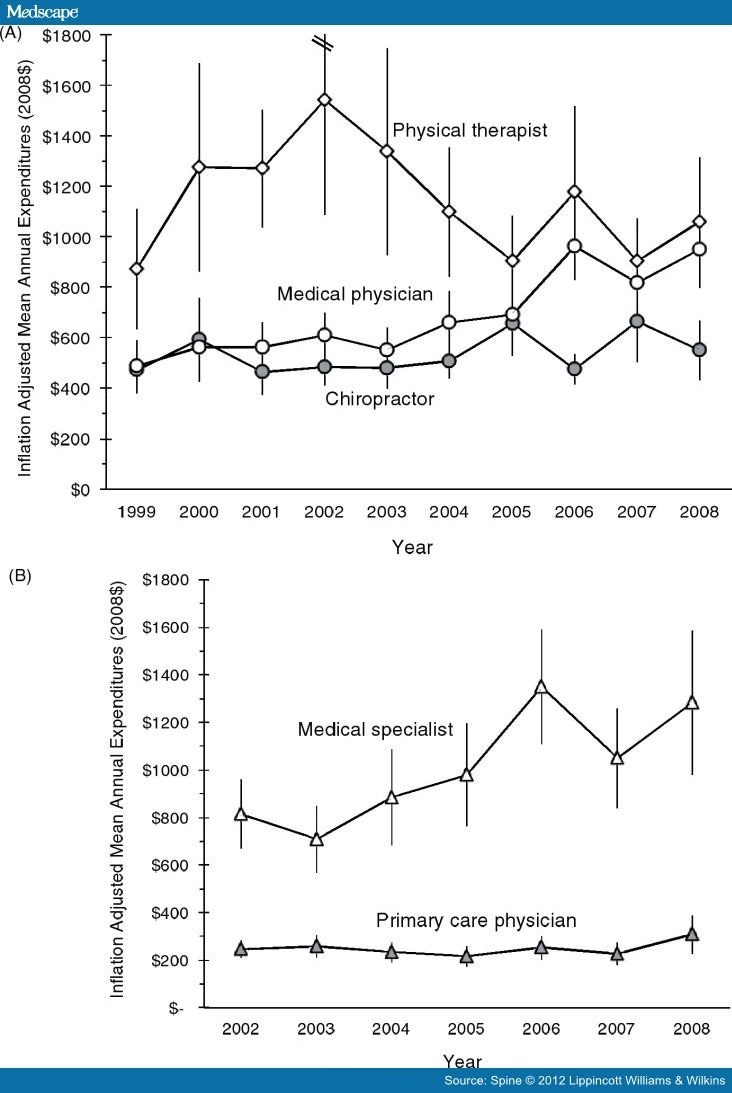
Medical Care: The mean inflation-adjusted expenditure increased by 95% (from $487 in 1999 to $950 in 2008). The Mean specialist care costs ranged from approximately $800 in 1999 to more than $1,200 by 2008.

Chiropractic Care: The mean expenditure varied much less, fluctuating between a low of $473 in 1999 and a high of $662 in 2007.

Physical Therapy: The annual inflation-adjusted mean expenditure per user on physical therapy peaked in 2002 at $1543 and apparently contracted thereafter; however, the confidence intervals for physical therapy were large, implying considerable variation in expenditures among physical therapy users.


Conclusions:

According to our estimates, the total annual expenditures on medical care for the management of spine conditions has grown significantly in recent years, whereas expenditures on chiropractic care and physical therapy have not experienced the same growth. Our study suggests that this growth in medical care is primarily due to increases in expenditures on Specialty care services (expenditures on primary care physician services were remarkably stable during the 10 years we examined).  Specialty care services include: Orthopedists / Orthopedic Surgery, Physiatry / Physical Medicine & Rehabilitation, Neurology and Neurosurgery.


Dr. Rommel Hindocha D.C. is the clinic director at Peninsula Spine & Sports Rehabilitation, located in San Mateo, California. Dr. Hindocha also practices at San Francisco Multi-Specialty Medical Group in San Francisco where he enjoys working with his Medical Specialist counterparts. In his San Mateo practice, Dr. Hindocha specializes in chronic back and neck pain, including: Sciatica, Hernaited Discs, Spinal Arthritis, Degenerative Disk Disease and Spinal Stenosis.

Wednesday, April 18, 2012

Top Hospitals for Emergency Care - Have 40% LOWER Death Rate

From: MedScape Medical news (login required).

More than 123.8 million people in the United States will make an ED visit, and 13% will end up being admitted to the hospital, according to the US Centers for Disease Control and Prevention.

Researchers analyzed more than 7 million Medicare patient records from 2008 to 2010 for 12 diagnoses: bowel obstruction, chronic obstructive pulmonary disease, diabetic acidosis and coma, gastrointestinal bleed, myocardial infarction, heart failure, pancreatitis, pneumonia, pulmonary embolism, respiratory failure, sepsis, and stroke.

Medicare patients admitted to the nation's best-performing hospitals for emergency medicine have a 40% lower death rate compared with all other hospitals, according to a new survey by HealthGrades, a Denver, Colorado–based provider of information about physicians and hospitals.

"If all hospitals performed at the level of the Emergency Medicine Excellence hospitals from 2008 through 2010, an additional 170,856 people could have potentially survived their emergency hospitalization," the HealthGrades release notes.

California

Alhambra Hospital Medical Center Alhambra, CA
Alta Bates Summit Medical Center - Summit Oakland, CA
Beverly Hospital Montebello, CA
Eden Medical Center Castro Valley, CA
French Hospital Medical Center San Luis Obispo, CA
John Muir Medical Center - Walnut Creek Walnut Creek, CA
Kaiser Permanente Woodland Hills Medical Center Woodland Hills, CA
Mercy General Hospital Sacramento, CA
Mercy Medical Center Redding Redding, CA
Mercy San Juan Medical Center Carmichael, CA
Peninsula Medical Center Burlingame, CA
    including    Mills Health Center San Mateo, CA
Presbyterian Intercommunity Hospital Whittier, CA
Saddleback Memorial Medical Center - Laguna Hills Laguna Hills, CA
    including    Saddleback Memorial Medical Center San Clemente San Clemente, CA
San Antonio Community Hospital Upland, CA
Scripps Mercy Hospital San Diego, CA
    including    Scripps Mercy Hospital Chula Vista Chula Vista, CA
Sequoia Hospital Redwood City, CA
Sierra Nevada Memorial Hospital Grass Valley, CA
Sutter Auburn Faith Hospital Auburn, CA
Sutter Delta Medical Center Antioch, CA
Sutter General Hospital Sacramento, CA
    including    Sutter Memorial Hospital Sacramento, CA
Sutter Roseville Medical Center Roseville, CA
White Memorial Medical Center Los Angeles, CA
Woodland Healthcare Woodland, CA

In the Bay Area, 6 Hospitals were in the top 5%. 

For other States, please follow this link.

Tuesday, April 17, 2012

Who will have Health Insurance in the future ?

From: Annals of Family Medicine. 2012;10(2):156-162.

It was previously estimated that the cost of a family health insurance premium would equal the median household income by the year 2025 by DeVoe and colleagues.

In an updated model, it is estimated that this threshold (i.e. the cost of a family health insurance premium would equal the median household income) will be crossed in 2033, with a "best case scenerio" that the PPACA (Patient Protection Affordable Care Act) may extend this date only to 2037.

When did Insurance Premiums rise to these historic levels ?

In the "managed care" era of the 1990's, health care inflation slowed. However, there was a public backlash and many employers had abandoned that model. In 1999, there was a steep increase in health insurance premium inflation, coupled with declining inflation in household incomes.

The passage of the Patient Protection and Affordable Care Act:

Interestingly enough, when there was debate in congress regarding health care reform in 2009/2010, health insurance premium inflation had slowed to levels not seen since the 1990's. Despite this slowing, the annual inflation rate of health insurance premiums still outpaced US household earnings, which stagnated from 2008 to 2011 and included an absolute reduction in average household income from $50,300 in 2008 to $49,800 in 2009. Therefore, as median household incomes decreased, healthcare premium inflation had increased.

The passing of the PPACA in 2010 saw the number of persons without health insurance in the United States rise to a historic high of 50.7 million people after 5 million Americans lost employment-based health insurance in the 2007–2009 recession. The irony of this was that the PPACA was supposed to reduce the number of uninsured. This can be explained by the language of the PPACA which is supposed to take place over several years however.

Model of median household income and health insurance premium increases:

In this model, from 2000 - 2009, health care premiums and median household incomes were compared. The average annual increase in insurance premiums was 8.0%; household incomes rose an average of 2.1%.

If health insurance premiums and national wages continue to grow at recent rates and the US health system makes no major structural changes, the average cost of a family health insurance premium will equal 50% of the household income by the year 2021, and surpass the average household income by the year 2033. If out-of-pocket costs are added to the premium costs, the 50% threshold is crossed by 2018 and exceeds household income by 2030.
  
Factoring in employers contribution:


Since most workers do not pay for the entire cost of healthcare, the model was updated to include employers contribution to family healthcare. The average amount an employee pays for a family health insurance premium plus out-of-pocket family health care expenses was factored in. Without major structural changes in the US health care system, the employee contribution to a family premium plus out-of-pocket costs will comprise one-half the household income by 2031 and total income by 2042.

 What is the effect with the passage of the PPACA:


There is no consensus among experts regarding the effect of the PPACA with regards to increasing or decreasing the costs on private health insurance. Assuming the PPACA actually slows cost growth, this threshold of insurance premiums exceeding household income is delayed only by 4 years.

What are Insurance Companies and employers doing to curb costs:

Employee contributions to insurance premiums and out-of-pocket expenses have grown faster than overall premium costs, suggesting that insurers have slowed the rate of growth in premiums by shifting more costs onto patients. Even though patients no longer face double-digit increases in insurance premiums each year, they now pay higher deductibles and co-payments and receive fewer covered services. 

In a 2010 Kaiser Family Foundation and Health Research and Educational Trust employer survey:

30% of employers reported having reduced the scope of health benefits or increased cost sharing.
23% increased the share of the premium a worker has to pay.

Among large firms (200 or more workers):'

38% reported reducing the scope of benefits or increasing cost sharing, up from 22% in 2009.
36% reported increasing their workers' premium share, up from 22% in 2009. 

Healthcare as a part of our GDP: 

Health care continues to comprise a growing portion of the total US economy. It has risen from 13.7% of gross domestic product (GDP) in 2000 to 17.3% of GDP in 2010. From 1960 to 1999, the growth of national health care expenditures exceeded the GDP by 2.4% per year. This same 2.4% differential occurred from 2000 to 2009. If health care costs continue to rise at current unsustainable rates, it is doubtful that affordable insurance coverage will be available for low-to middle-income Americans in the near future. Further, our model did not include the taxes paid by American workers each year to finance Medicare and Medicaid—nearly $900 billion in 2009—which may increase with the PPACA. 

How does our Healthcare policies affect other aspects of the economy:

It has been observed that expensive US health care increases production costs and makes American manufactured goods less competitive, which results in lower wages and fewer jobs in the manufacturing industry. For example in 2006, General Motors' spent $1,500 more than Toyota in health care costs per car.  

Doctors poll results on Affordable Care Act (ACA) aka "Obamacare"

From: WebMD, MedScape, business of medicine. Log in required.

The ACA is a hotly debated topic. Specifically, the individual mandate requiring individuals to purchase health care coverage. In fact, this will be debated in the Supreme Court this June.

Here are some of the highlights of the poll results from US Physicians:

Do you think it is or is not constitutional for the US government to require individuals to purchase healthcare insurance or else pay a penalty?

44% - Yes, it is constitutional
56% - No, it is not constitutional

Do you think all individuals should or should not be required to purchase healthcare insurance?

33% - It should be required; the ability to fund healthcare reform depends on instituting the individual mandate
14% - It should be required; it is wrong for uninsured persons to seek healthcare at emergency departments and then not pay
34% - It should not be required; the government should not force people to buy a product or service
18% - It should not be required; if healthcare reform cannot succeed without this mandate, then it is not a well-designed plan

Should the Supreme Court strike down the individual mandate but keep all other elements of the Affordable Care Act?

11% - Yes; the other policies of healthcare reform are useful, even if the individual mandate is eliminated
12% - Yes; even though the Affordable Care Act lacks a severability clause, the court can still selectively void inclusions of the mandate
51% - No; the overall economic structure of healthcare reform and the Affordable Care Act depends on the inclusion of the mandate
26% - No, because the Affordable Care Act lacks a severability clause that would preserve the rest of the law

Do you predict that the individual mandate will be upheld?

46% - Yes, it will be upheld
54% - No, it will not

Do you support or oppose the Affordable Care Act?

39% - Strongly support
8% - Somewhat support
4% - Neutral
43% - Strongly oppose
0% - Uncertain

Friday, December 16, 2011

Manipulation or Microdiskectomy for Sciatica ?

From: J Manipulative Physiol Ther. 2010 Oct;33(8):576-84.

Spinal manipulation (sometimes referred to as a 'spinal adjustment') is the Chiropractors primary therapy. Microdiscectomy is a surgical procedure which removes a portion of the facet joint (part of the spine) as well as a portion of the herniated disc which is "pinching" the nerve root.


This study concluded: "Sixty percent of patients with sciatica who had failed other medical management benefited from spinal manipulation to the same degree as if they underwent surgical intervention. Of 40% left unsatisfied, subsequent surgical intervention confers excellent outcome. Patients with symptomatic LDH failing medical management should consider spinal manipulation followed by surgery if warranted."

Conclusions: Have sciatica ? Considering the surgical options ? Why not try Chiropractic Spinal Manipulation which, according to this study, has a 60% chance of giving you the same outcome as if you were to have surgery. If all else fails, the surgical option is always available right ? Well, why not try non-surgical VAX-D Spinal Decompression Therapy.

Dr. Hindocha performs Chiropractic therapy and non-surgical Spinal Decompression therapy in San Mateo, California. Have you been diagnosed with Sciatica, a Herniated, Bulging or "Slipped" disc ? Call Peninsula Spine & Sports Rehabilitation at (650) 347-2225 to find out if you can benefit with Chiropractic care or VAX-D Spinal Decompression therapy.


Do Chiropractic Physician services for the treatment of Low Back and Neck Pain improve the value of health benefit plans ?


Traditionally, Doctors and Insurance plans have often disagreed on how to manage a patients health. For a Doctor, we recommend treatments and diagnostic testing (X-ray, MRI, CT, nerve testing) which we feel will give us the most accurate diagnosis and therefore formulate a treatment plan tailored to our patients needs. Insurance plans see their clients as liabilities and have therefore have hired third party individuals specifically to deny care and therefore cut costs of medically necessary treatment and diagnostics.

The Foundation for Chiropractic progress funded the following study to determine the COST SAVINGS to health benefit plans utilizing Chiropractic care for neck and low back complaints compared to Physician visits:

In a 2009 study titled "Do Chiropractic Physician Services for Treatment of Low Back and Neck Pain Improve the Value of Health Benefit Plans ? An Evidence-Based Assessment of Incremental Impact on Population Health and Total Health Care Spending" by Niteesh Choudhry, MD, PhD from Harvard Medical School and Arnold Milstein, MD, MPH from Mercer Health and Benefits, San Francisco concluded:

"When considering the effectiveness and cost together, chiropractic physician care for low back and neck pain is highly cost effective, [and] represents good value in comparison to medical physician care and to widely accepted cost-effectiveness thresholds. Because we were unable to incorporate savings in drug spending commonly associated with US chiropractic care, our estimate of its comparitive cost effectiveness is likely understated."

What was compared was the costs associated with Chiropractic physician care for episodes of neck and low back pain vs. costs associated with traditional Medical care (Medical doctor visits, Hospital visits, outpatient Physical Therapy and interventions). Note: the costs associated with medications WERE NOT factored into the calculations therefore the estimate of its comparitive cost effectiveness is likely understated.

Dr. Rommel Hindocha is a practicing Chiropractor in San Mateo. We offer quality Chiropractic care for neck and low back conditions. We are participating providers on most medical insurance plans including PPO, HMO, Kaiser, Workers Compensation and accepting automobile insurance plans (Medical Payments). If you, or someone you know, has a neck or low back complaint, call Dr. Hindocha at Peninsula Spine and Sports Rehabilitation in San Mateo at (650) 347-2225.

Tuesday, November 29, 2011

Whiplash - Cervical Zygapophysial Joint Pain After Whiplash

From: On Cervical Zygapophysial Joint Pain After Whiplash. Bogduk, Nikolai MD, PhD. Spine: 1 December 2011 - Volume 36 - Issue - p S194–S199.

What is Whiplash ? 

Whiplash is an injury to the neck and upper back that can occur following an auto accident. Whiplash can also occur in other circumstances where the neck is forced backwards and then forwards such as a fall or during a sporting event. In automobile accidents, whiplash occurs as a result of sudden "acceleration - deceleration" forced to the spine and soft tissue structures (tendons, ligaments and muscles):

Whiplash Associated Disorder (WAD), describes a more serious and chronic condition which can include symptoms other than just pain and stiffness in the neck such as: nausea, dizziness, headaches, ringing in the ears, concussion, etc. 

In automobile accidents, the most common form of impact for whiplash is a rear end type of impact. There are many factors contributing to the injury including: speed of impact, type of seat, type of vehicle, did the occupant brace for impact ? was the occupant looking straight ahead or turned ? etc.

Whiplash can be quantified on X-ray as an "S-Shaped curve": 

It has been well documented that soft tissue structures are injured and which are responsible for localized pain and stiffness. Pain and tingling down the arm(s) can be a sign of a more serious condition such as a cervical disc herniation or a brachial plexus lesion or compression. 

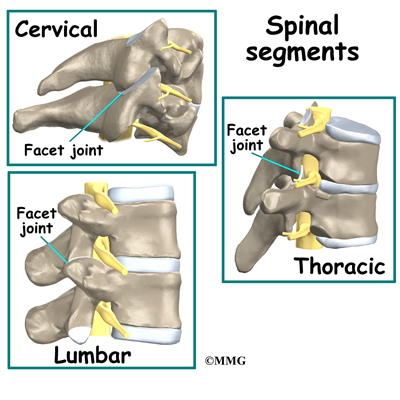
This recent study suggests what Chiropractors have always known, that there is injury to cervical zygapophysial joints OR facet joints following whiplash. Facet joints are located at each level of our vertebrae and are the joints responsible for the "popping or crackling sounds" that we hear from our spines. Facet joints are also the joints that are "adjusted" when Chiropractors manipulate the spine. Perhaps that is why so many patients have found relief with Chiropractic following an automobile accident causing whiplash

Diagram showing Facet joints:

Have you been injured in an automobile accident and are suffering from whiplash, headaches or an injury to a spinal disc and nerve ? Call us at (650) 347-2225 to get a correct diagnosis and appropriate treatment. We offer treatment for soft tissue injuries, injuries to the facet joints and cervical disc's. Dr. Hindocha is a Chiropractor in San Mateo who has had over 10 years of experience managing these difficult cases. Moreover, Dr. Hindocha shares his office space with a Physical Medicine & Rehabilitation and Orthopedic specialist should you require advanced care. We offer: Chiropractic care, non-surgical spinal decompression therapy, PT modalities and procedures, therapeutic exercises such as cervical and lumbar core stabilization programs and traction procedures. We will work with your lawyer or can recommend an attorney qualified for your case. Dr. Hindocha's paperwork and medical reports can help support your case to avoid costly litigation.

Assessing the outcomes after Spinal Fusion surgery.

From: Perioperative Morbidity and Mortality After Anterior, Posterior, and Anterior/Posterior Spine Fusion Surgery. Stavros G. Memtsoudis, MD, PhD; Vassilios I. Vougioukas, MD, PhD; Yan Ma, PhD; Licia K. Gaber-Baylis, BA; Federico P. Girardi, MD. Spine. 2011;36(22):1867-1877. © 2011 Lippincott Williams & Wilkins.

The utilization of Spinal fusion techniques have increased dramatically despite the relatively few studies showing the safety of this procedure. There is also a relative lack of studies comparing the relative spinal surgical techniques and the outcomes associated with them.


This study was designed to assess the Morbidity (the rate of incidence) and Mortality (the measure of the number of deaths) and to determine the independent risk factors for in-hospital death. associated with the various surgical approaches to spinal fusion surgery.

The outcomes being measured were: Perioperative (after operation) of Anterior Spinal Fusion (ASF), Posterior Spinal Fusion (PSF) and APSF (Anterior Posterior Spinal Fusion). 


Here are some X-rays, post-operative:


Results of the study:


There was an increased incidence of perioperative complications and adjusted risk of in-hospital mortality among hospital admissions undergoing APSF and ASF when compared to PSF procedures.

The highest rates of fatal outcomes and complications were associated with procedures using the anterior thoracic approach.

Risk factors for in-hospital mortality included the following: male gender, advanced age, procedures indicated for metastatic disease and trauma, as well as the presence of several comorbidities and perioperative complications.

Procedures involving the anterior spine were associated with higher morbidity and mortality in our study, despite being performed in younger individuals with lower comorbidity burden.

The highest rate of morbidity and mortality was seen in APSF patients, which can be explained by longer surgical times, more blood loss, and increased surgical complexity. 

When studying patient demographics and their association with mortality, we found increased independent risk of a fatal event after spine fusion among men.

We identified an increased incidence of morbidity and risk for mortality in patients with advanced age. Patients over the age of 75 years made up almost one- third of all mortalities, despite representing less than 9% of the spine surgical population in this study.

Pulmonary circulatory disease, congestive heart failure, renal disease, and coagulopathies were associated with the highest increases of risk for perioperative mortality.

Perioperative complications were also associated with increases in the odds of a fatal event. Pulmonary embolism, perioperative shock, ARDS, and cardiac complications were associated with the highest risk of mortality. All of these events had the highest incidence among APSF patients.

It was determined that APSF and ASF carried an increased adjusted risk of in-hospital mortality and greater incidence of in-hospital complications when compared to PSF procedures.

What can we learn from this study ? Like the old saying goes "an ounce of prevention equals a pound of cure". Aside from unforeseen circumstances such as trauma, there are ways we can help prevent our spines from getting to this level of degeneration.

1.) Have a spinal exam and check up.

2.) Don't ignore early signs such as: recurring back pain that may self-resolve or resolve with medications. In my experience, most cases of spinal degeneration and herniated discs have manifested themselves in the past and have not been adequately or properly treated. Chiropractic therapy is a drugless, non-surgical, intervention which can help with many types of back pain.

3.) For those of you who have already reached the advanced stages of spinal arthritis, osteroarthritis, degenerative disc disease, sciatica or have one or multiple herniated discs, VAX-D spinal decompression therapy is an alternative approach to some types of surgery and "endless" epidural injections.

4.) Exercise, lose weight and keep a healthy lifestyle.

Dr. Rommel Hindocha is a Chiropractor in San Mateo California. In addition to Chiropractic therapy, he does perform non-surgical Spinal Decompression therapy at 101 S. San Mateo Drive, Suite 200, San Mateo, CA  94401. You can reach Peninsula Spine & Sports Rehabilitation at (650) 347-2225.


Wednesday, November 2, 2011

Is there a genetic predisposition to "Back Disease" ?

J Bone Joint Surg Am. 2011;93:225-229. Abstract

In an analysis of a database of more than 2 million people, first-degree and third-degree relatives of people with lumbar disc disease had a significantly increased relative risk of developing the back condition themselves compared with expected rates for the general population. "The results of this study support a heritable predisposition to lumbar disc disease," lead author Alpesh A. Patel, MD, and colleagues from the departments of Orthopaedics and Biomedical Informatics, University of Utah School of Medicine, Salt Lake City, report in the February 2 issue of the Journal of Bone and Joint Surgery.

To test the hypothesis that lumbar disc disease may be inherited, the authors analyzed data from both the Utah Population Database, which permits the tracking of medical information on the founding pioneers of Utah and their descendents, and the University of Utah Health Sciences Center data warehouse, which has diagnosis and procedure data on all patients treated at the University Hospital. Together, the databases contain information on more than 2.4 million patients. Only patients and control participants with at least 3 generations of genealogical data were included in the study.

Of those individuals, 1254 people had at least 1 diagnosis of lumbar disc disease or lumbar disc herniation, along with the requisite genealogical data. The authors tested for heritability in 2 ways: by estimating the relative risk for lumbar disease in relatives and by determining a genealogical index of familiality (GIF). They compared their findings in affected families with the expected results for the general population of Utah.

First-degree relatives of people with lumbar disc disease had a relative risk of 4.15 of having the disease themselves (95% confidence interval [CI], 2.82 - 6.10; P < .001). In third-degree relatives, the relative risk was 1.46 (95% CI, 1.06 - 2.01; P = .027). Relative risk was slightly elevated in second-degree relatives, at 1.15, but this was not significant (95% CI, .71 - 1.87; P = .60), perhaps because of limitations in the data.

Conclusions:

This study suggests that first-degree relatives and third degree relatives have a statistically significant of developing lumbar disc disease and that there may be a genetic component related to disc disease.

Future research can potentially identify the genes leading lumbar disc disease which often accompanies lumbar disc herniations and spinal arthritis.

Chiropractic spinal manipulation has been thought to restore motion to individual spinal segments, thus increasing range of motion and equalizing the bio mechanical loads on the spinal structures. In cases of Sciatica, Disc Herniations and advanced Spinal Arthritis and Lumbar Disc Disease, VAX-D Spinal Decompression Therapy is a relatively new therapy which has shown good results in relieving pain, reduce the size of the disc herniations and increasing functional and overall quality of life for those suffering from these conditions.

Dr. Hindocha, at Peninsula Spine & Sports Rehabilitation in San Mateo, offers gentle Chiropractic therapy and non-surgical Spinal Decompression Therapy. Dr. Hindocha offers Chiropractic therapy in his San Mateo and San Francisco locations and VAX-D Spinal Decompression Therapy in San Mateo. Please call us at (650) 347-2225 to see if you are a candidate and schedule your consultation.

Low Back Pain in Adolecents and Teens - Imaging

From: American Academy of Pediatrics (AAP) 2011 National Conference and Exhibition; Abstract #14782. Presented October 14, 2011.
  
No Imaging Needed for Most Low Back Pain in Teens
Low back pain is common in adolescents and teens. Most cases of low back pain are diagnosed as "mechanical low back pain", which is a diagnosis of "exclusion", ruling out any serious pathologies.

Mechanical low back pain is common in the pediatric population, and recent studies have shown that undiagnosable mechanical low back pain accounts for up to 78% of cases in adolescents. The most common pathologic cause of back pain in this age group is spondylolysis and spondylolisthesis

Most cases of low back pain in children will get better with conservative management, such as Chiropractic and do not need to be diagnosed with radiographic studies, researchers said here at the American Academy of Pediatrics (AAP) 2011 National Conference and Exhibition.

Parents often worry as low back pain can appear to be very serious at it's initial onset. However, the routine use of X-rays, CT scans and bone scans can complicated matters as it can expose your child to relatively high doses of radiation.

This study followed 2846 children aged 10 to 19 years who were seen at their institution with low back pain between 2000 and 2008. Most (63%) were female, and the average age was 14 years.
In 79% of the patients (n = 2244), the cause of their low back pain went undiagnosed. Spondylolysis, which was diagnosed in 272 patients (9.6%), was found by plain radiography in 234 patients (86%), by bone scanning in 34 patients (12.5%), and by computed tomography (CT) in 4 patients (1.5%).

Dr. Dennis Drummond, MD, who headed the stated concluded: "Our message is try and treat the low back pain conservatively. If they are 50% to 60% improved when you see them in 6 weeks, you’re probably on the right track. If the pain is all gone at 3 months, get them ready to go back to sports or usual activities. If there is just as much pain at 6 weeks, go back to the old system of more investigation, but the majority will get better by then."

At Peninsula Spine & Sports Rehabilitation in San Mateo, Dr. Hindocha treats Pediatric patients with gentle Chiropractic therapy, soft tissue procedures and therapeutic exercises for rehabilitation. Dr. Hindocha does not routinely prescribe the use of X-rays on his patients, Pediatric or Adult, but does so when there is a need or clinical justification for use of these procedures. If your child has low back pain, please call us at (650) 347-2225 to schedule a consultation.

Sunday, October 30, 2011

Diagnosis - Thoracic Outlet Syndrome

Thoracic Outlet Syndrome

Thoracic outlet syndrome is a type of Brachial Plexus lesion involving compression of the neural (nerves) and/or vascular (blood vessels) structures between the rib cage, collar bone and neck:


Compression can occur at 3 sites:

1.) At an abnormal cervical rib.
2.) At the clavicle (collar bone).
3.) At the anterior muscles of the neck called the Scalenes.


Symptoms:
Pain, numbness/tingling in the pinky and ring fingers (4th and 5th digits) and the inner forearm. Pain and tingling in the neck and shoulders areas which can be worsened by carrying something heavy. Poor circulation in the hand or forearm (a bluish color, cold hands, or a swollen arm.) Weakness of the muscles in the hand and arm.

Causes:

Sporting injuries, trauma such as Whiplash resulting from car or motorcycle accidents, poor posture, carrying heavy backpacks, birth trauma and other rare conditions such as tumors can cause Thoracic Outlet Syndrome.

Diagnosis:

Diagnosis of TOS is made by seeing a Doctor familiar with this condition which includes a thorough history, physical exam and Orthopedic and Neurologic tests and may include diagnostic tests such as: X-ray, MRI, CT angiogram and Electrodiagnostic evaluation (nerve tests).

Treatment:

In non-severe cases, most cases of Thoracic Outlet Syndrome can resolve without the need for surgical intervention. Chiropractic treatment includes: cervical spine and clavicle manipulation, soft tissue procedures such as transfriction massage or myofascial release, therapeutic exercises to stretch the scalene muscles and postural exercises.

At Peninsula Spine & Sports Rehabilitation in San Mateo, we offer a Chiropractic solution which is unique in that it addresses the osseous (bony) and soft tissue causes of Thoracic Outlet Syndrome. This condition is becoming increasingly prevalent due to poor posture associated with long term computer use. Call us at (650) 347-2225 for your initial consultation with Dr. Hindocha.

Recovery of Brachial Plexus Lesions Resulting from Heavy Backpack use.

From: BMC Musculoskeletal Disorders. 2011;12(1) © 2011 BioMed Central, Ltd.

Brachial plexus lesions as a consequence of carrying a heavy backpack have been reported, but the typical clinical course and long-term consequences are not clear. Here we evaluated the clinical course and pattern of recovery of backpack palsy (BPP) in a large series of patients.

Eighty percent of the patients recovered totally within 9 months after the onset of weakness. Prolonged symptoms occurred in 15% of the patients, but daily activities were not affected. The weight of the carried load at the symptom onset significantly affected the severity of the muscle strength loss in the physiotherapeutic testing at the follow-up. The initial electromyography did not predict recovery. Genetic testing did not reveal de novo hereditary neuropathy with pressure palsies.
 
Conclusions: The prognosis of BPP is favorable in the vast majority of cases. Electromyography is useful for diagnosis. To prevent brachial plexus lesions, backpack loads greater than 40 kg should be avoided.

What is a Brachial Plexus injury ?

A brachial plexus injury is an injury to the the network of nerves that sends signals from your spine to your shoulder, arm and hand. A brachial plexus injury occurs when these nerves are stretched or, in the most serious cases, torn. This happens as result of your shoulder being pressed down forcefully while your head is pushed up and away from that shoulder.  

Brachial Plexus injuries arise from: contact sports, poor posture, heavy backpack use (above), Whiplash injuries arising from auto or motorcycle accidents, infants can acquire this condition during birth and other rare occurrences such as tumors.

Most Brachial Plexus lesions are treated conservatively (with therapy and/or rest) but severe lesions require surgical intervention.


Symptoms:

Neck pain, burning, numbness/tingling and/or weakness into one or both arms.

One of the most common forms of Brachial Plexus lesions is a condition called Thoracic Outlet Syndrome which will be discussed in a separate post. 

At Peninsula Spine & Sports Rehabilitation is San Mateo, Dr. Hindocha offers Chiropractic treatment of non-surgical Brachial Plexus lesions. Please call us at (650) 347-2225 for an initial consultation.

Saturday, October 29, 2011

Prevalence and Tracking of Back Pain From Childhood to Adolescence

It is generally acknowledged that back pain (BP) is a common condition already in childhood. However, the development until early adulthood is not well understood and, in particular, not the individual tracking pattern.

Prevalence of neck pain, mid-back pain and low back pain was tracked in children ages 9, 13 and 15.

The results were:

The prevalence estimates for children at the ages of 9, 13, and 15, respectively, were for Back Pain 33%, 28%, and 48%.

For Low Back Pain: 4% (9 y/o), 22% (13 y/o), and 36% (15 y/o).

For Mid Back Pain: 20% (9 y/o), 13% (13 y/o), and 35% (15 y/o)

Neck Pain 10% (9 y/o), 7% (13 y/o), and 15% (15 y/o).

Seeking care for Back Pain increased from 6% and 8% at the two youngest ages to 34% at the oldest.

What are the causes of back pain which were dismissed as "growing pains" years ago ? Numerous studies have reported: Back Pack use, texting, use of computers and lap tops and sporting injuries.

One of the main reasons that Chiropratic has become an ever increasing utilized service is it's drugless approach which is embraced by more and more parents and Pediatricians. Adolescents and teens typically have a very quick response and it is our hope that early spine care can stave off more serious spine problems in adulthood.

At Peninsula Spine & Sports Rehabilitation in San Mateo, Dr. Hindocha treats adolescents and teenagers with neck, mid-back and low back problems with gentle Chiropractic therapy including: therapeutic exercises and gentle soft tissue procedures. Dr. Hindocha's experience has been adolescents and teens respond very quickly to Chiropractic therapy. We are located in San Mateo, CA, and offer gentle Chiropractic therapy. Talk to your Pediatrician today !

Does eating chocolate lower stroke risk ?

Chocolate lovers may have another reason to indulge. A new study shows that consuming chocolate on a regular basis may decrease stroke risk by 20%.

According to a recent study published in the October 18 issue of the Journal of the American College of Cardiology.

Chocolate is thought to have cardiovascular benefits resulting from the flavonoids in cocoa that have antioxidant properties. Antioxidants protect the body from damage caused by free radicals and can suppress oxidation of low-density lipoprotein. Dark chocolate consumption has also been shown to reduce blood pressure, which is a strong risk factor for stroke, as well as improve endothelial and platelet function and heighten insulin resistance.

Interestingly, women with hypertension had a reduction of stroke risk with chocolate consumption that was not statistically significant, whereas those without hypertension had a statistically significant risk reduction for stroke